Operation & Services

Home > Services > Single Service

Operation & Services

Trading Fuel Industry & Marine is one of the services provided by Rizmala Global Energy International which includes purchasing, selling, marketing and distributing non-subsidized fuel products for sales areas throughout Indonesia and International. Rizmala Global Energy International has experience more than 8 years in selling, marketing, and distributing non-subsidized fuel products. This is reinforced by well-established connections to all stakeholders, as well as the oil sales bundling system with the Loco, Franco, Vendor Held Stock (VHS) scheme, investment and rental storage and Fuel Management System (FMS).

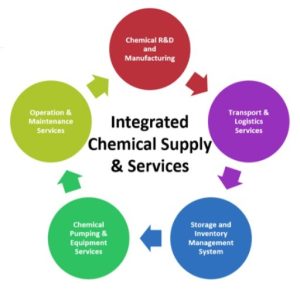
Chemical Integrated Supply & Services by Rizmala Global Energy International offers service from upstream, midstream to downstream of the oil and gas industry. Products and services offered include Drilling Fluid Chemicals, Upstream & Refinery Specialty Chemicals, Chemicals for Enhanced Oil Recovery (C-EOR), and Fuel Additives for Downstream/Retail businesses.
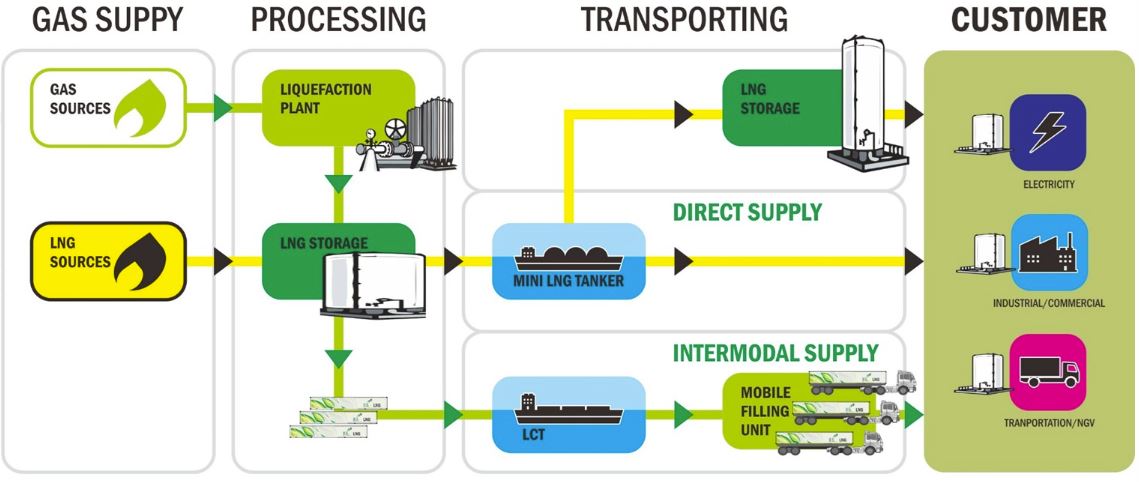
CNG Operation Model. Compressed natural gas (CNG) is a fuel gas mainly composed of methane (CH4), compressed to less than 1% of the volume it occupies at standard atmospheric pressure. It is stored and distributed in hard containers at a pressure of 20–25 megapascals (2,900–3,600 psi; 200–250 atm), usually in cylindrical or spherical shapes.

Liquefied Natural Gas (LNG) is natural gas (predominantly methane, CH4, with some mixture of ethane, C2H6) that has been cooled down to liquid form for ease and safety of non-pressurized storage or transport. It takes up about 1/600th the volume of natural gas in the gaseous state at standard conditions for temperature and pressure.

The gas stream is typically separated into the liquefied petroleum fractions (butane and propane), which can be stored in liquid form at relatively low pressure, and the lighter ethane and methane fractions. These lighter fractions of methane and ethane are then liquefied to make up the bulk of LNG that is shipped.

Natural gas was considered during the 20th century to be economically unimportant wherever gas-producing oil or gas fields were distant from gas pipelines or located in offshore locations where pipelines were not viable. In the past this usually meant that natural gas produced was typically flared, especially since unlike oil, no viable method for natural gas storage or transport existed other than compressed gas pipelines to end users of the same gas. This meant that natural gas markets were historically entirely local, and any production had to be consumed within the local or regional network.

Developments of production processes, cryogenic storage, and transportation effectively created the tools required to commercialize natural gas into a global market which now competes with other fuels. Furthermore, the development of LNG storage also introduced a reliability in networks which was previously thought impossible. Given that storage of other fuels is relatively easily secured using simple tanks, a supply for several months could be kept in storage. With the advent of large-scale cryogenic storage, it became possible to create long term gas storage reserves. These reserves of liquefied gas could be deployed at a moment’s notice through regasification processes, and today are the main means for networks to handle local peak shaving requirements.

Aerated concrete was developed in Sweden in 1924. In Europe, aerated concrete has since become one of the most widely used building materials, and it is also used more and more often in many other countries. Aerated concrete as a lightweight, firm, highly insulating and durable construction material is produced in many densities and strength classes.

Aerated concrete offers a wide range of possibilities to increase the building quality while reducing the costs on the building site. Aerated concrete is produced from a mixture of quartz sand and/or fly ash (PFA), lime, cement, gypsum/anhydrite, water and aluminum and is cured by steam curing in autoclaves. Because of its outstanding properties, aerated concrete is used in many construction projects, such as residential, commercial and industrial buildings, schools, hospitals, hotels and other structures.

Aircrete is an air-entrained concrete which consists of up 85% volume percent of air. The solid matter is a crystalline bonding agent called tobermorite. In its chemical composition, tobermorit contains silicon dioxide, calcium oxide and water. In addition to the binder phase tobermorite, aerated concrete contains quartz grains and small amounts of other minerals. The silicon dioxide is obtained from quartz sand, fly ash (PFA) or cracked quartzite. Silicon dioxide can also be obtained as a by-product of other processes, e.g. foundry sand. Calcium oxide is obtained from quicklime, hydrated lime and cement. Small quantities of gypsum/anhydrite are added as a catalyst and to optimize the properties of the aerated concrete. Aluminum powder/paste is used as an expanding agent. In specific applications, additional (chemical) components can be added to improve the properties of the aerated concrete during production and in the final product. Special active ingredients enable the use of certain waste materials as valuable new raw materials for the production of high-quality aerated concrete, which supports sustainability and the process cycle.

Advantages of aerated concrete: